
Relational Efficiency
A technical justification for having a big ol’ bleeding heart.

Engineers love talking about “efficiency,” but the term is often misunderstood. Efficiency measures any success against the cost required for that success. In formal usage, the numerator and denominator of the efficiency fraction are usually terms with the same units: “For 100 joules of energy entering the system as fuel, we get 35 joules out as electricity. η = 35%.”
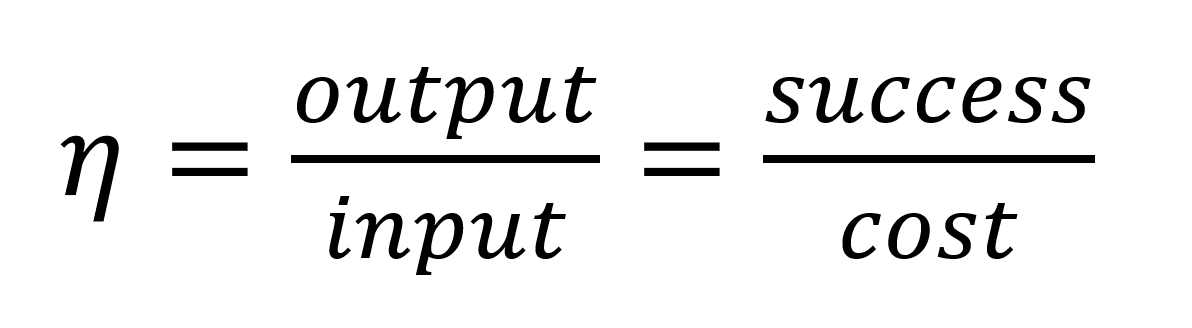
In popular usage, however, the units usually differ: “For this huge effort, I only made fifteen dollars. That was inefficient.” I don’t begrudge the non-engineer who wants to use efficiency as a framework for decision-making. In fact, I encourage it. However, efficiency analysis is only useful if the units make sense.
In almost every case, the success unit used in efficiency discussions is money, which, though convenient, is completely irrational. Money has no inherent value until it is converted for a good; it is effectively a coupon for deliverable energy. Restated in a less engineering and more philosophy way: money is storable freedom. Freedom, similarly, is worthless until it is converted to a good. When I was single, I was free to ask out any woman I found interesting; eventually I spent that freedom to acquire the good I actually sought–a wife. The object for which freedom or money is spent is the actual unit measure of success.
All meaning exists in the form of relationships, and that includes the meaning of human life. If my life is made out of relationships, then relational flourishing is the best success unit in my efficiency fraction. Cost units must be spendable. The most valid cost unit is time, because it is a truly and universally limited resource and it is constantly being spent. Money or freedom can also be valid cost units, because they are spent to achieve an end goal.
My buddy’s wife hinted at wanting a nice dinner out for their Valentine’s date. After calling numerous restaurants, he secured the last reservation in town. The restaurant in question had vastly increased their prices for a Valentine’s special, and he doubted the value of it, so he canceled the reservation. We weighed his options. If the measure of success was money, then of course the most efficient course of action was for him to pack a ham sandwich picnic for their Valentine’s date. Then, he could bank the difference in cost, invest the money in the market, wait 35 years, realize the gains and… take his wife out to a nice dinner? When he put honoring his wife as the success unit and money as the cost unit, the most efficient course of action became obvious. He quickly rebooked the dinner reservation, and they had a great time. The money-efficient thing to do was to cheap out; the relationally efficient thing to do was to splash out.
It may seem that relational efficiency doesn’t apply until there’s an abundance of resources. To have a relationship with someone, you both have to survive. If there isn’t enough food, healthy shelter, clothing, or transport, then a $300 dinner out is likely not the most efficient use of resources. But all optimization problems assume limited resources. You only get so many days and so many dollars. If I’m strapped for cash, I can choose to cook in community and share a big pot of red beans and rice. I can choose to live with roommates to conserve financial resources and build relationships at the same time. The point is to abandon the assumption that every value analysis must be viewed in terms of “make money, spend money on the thing I want,” which is rarely the most efficient path to the thing you want.
Efficiency-minded people may feel a tension between “the efficient choice” and the relational choice. The best path forward is not to abandon efficiency as a decision-making tool, but to use it correctly by choosing proper units of measure. My two-year-old simply can’t put her shoes on her own feet as fast I can put them on for her. Assuming my cost unit is time, my response to her when leaving the house depends on my success unit–my ultimate goal. If my goal is to get where I’m going, the most time-efficient approach is to pick her up and put her shoes on for her. If my goal is to raise an independent human, the most time-efficient approach is to let her painstakingly figure out that her crocs are on the wrong feet and encourage her as she tries again. It may be slower, but it is not less efficient; I get a greater result for my input cost.
Here’s how the math works out for carpooling with a friend to lunch with “man-minutes together” as the success unit and “man-minutes” as the cost unit. Without carpooling, each person takes an hour off of work, drives ten minutes to the lunch spot, hangs out for forty minutes, and drives ten minutes back to work. You and your friend spend 80 man-minutes together during a total of 120 man-minutes invested–a relational efficiency of η = 67%. If one party is willing to invest an extra twenty minutes picking up/dropping off the other, then you and your friend can spend 120 man-minutes relating for a total time investment of 140 man-minutes. The resulting relational efficiency for the pair is η = 86%, and the personal relational efficiency for the one getting picked up is η = 100%. Do I do the math with numbers when making these decisions? Of course not. But the numbers bear out the story that efficiency analysis, properly used, can add more meaning to life.
The efficiency framework holds: what do I actually want? With a fixed set of resources, what’s the best way to get that? To paraphrase the old parable on the wall at Jimmy John’s: if your ultimate goal is time at the beach, then becoming a subsistence fisherman is astronomically more efficient than upskilling for a higher-paying job so you can afford a longer yearly vacation. Efficiency analysis of all types is necessarily limited in scope, but relational efficiency analysis assumes indefinite or life-long relationships in most cases. When the scope of what may be spent is expanded, the most efficient use of resources often shifts; extra investment can produce outsized results. For my kid, an extra few minutes invested leads to life-long growth. For my lunch buddy, an extra few minutes means 33% more time together.
Here is your technical encouragement: spend a bit more of yourself to achieve far greater results. What you actually want is healthy relationships–real friends, real family. Spend extravagantly to build those relationships. Presence is the most time-efficient relationship builder; money facilitates presence. And money has a way of working itself out when your success units are clearly defined.
In short... carpool.
As a non-nerd, I even benefited from this